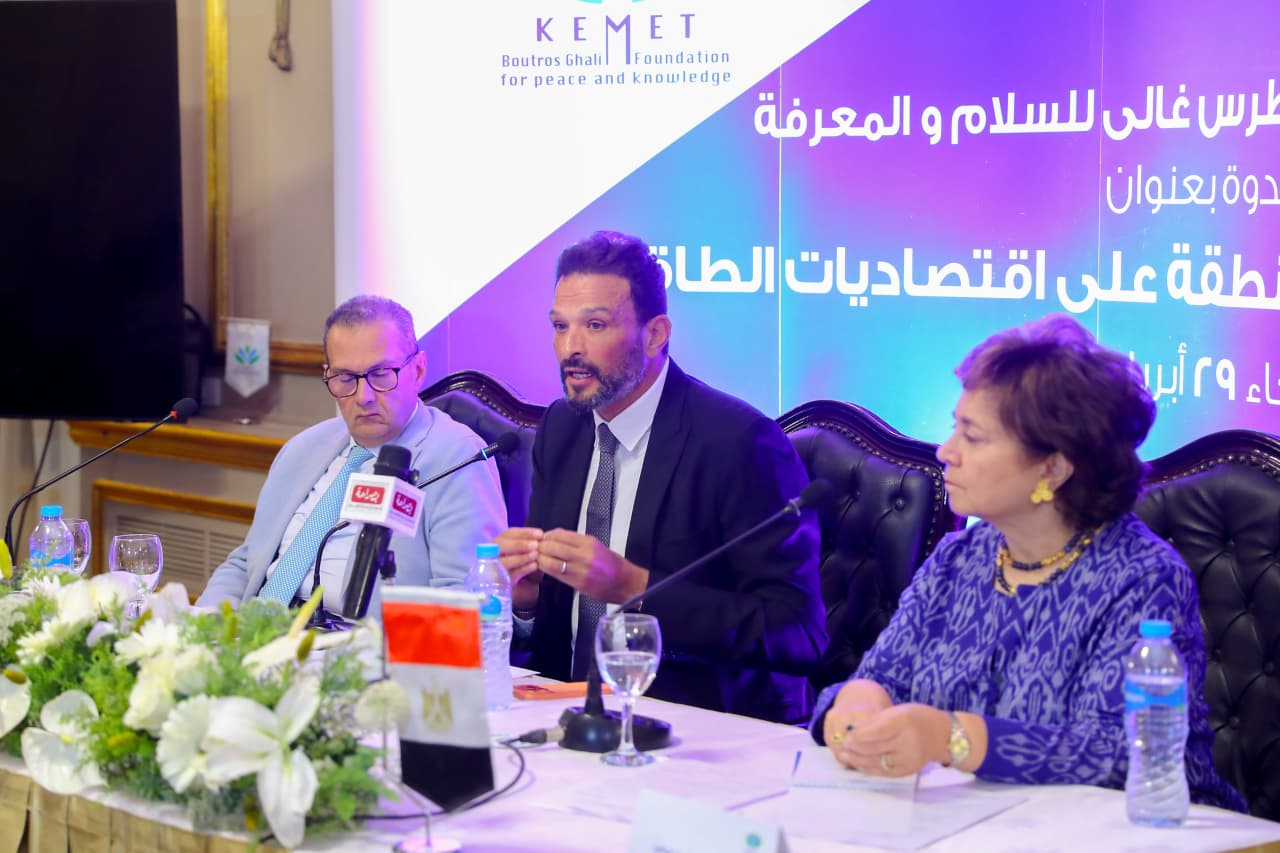


the boutros ghali foundation for peace and knowledge held a seminar titled “the impact of war in the region on energy economics” at the diplomatic club headquarters on wednesday, april 29.
The seminar featured an in-depth discussion on major global transformations in the energy sector and their direct impact on the Egyptian economy. Among the speakers was Mr. Ayman Abbas, Chairman of ADES Holding Company and Chairman of Intro Holding Group, who addressed the concept of the “weaponization of energy.” He noted that oil remains a decisive factor in the global economy despite the shift toward clean energy. He explained that recent years have witnessed a decline in financing for exploration and drilling projects due to changes in international policies, leading to fewer new discoveries, which may affect future supply levels. He also pointed to clear imbalances in oil pricing, evident during sharp increases in times of crisis, as well as the cascading impact of the energy crisis across various sectors—from industry to food—emphasizing the importance of viewing crises as opportunities for economic repositioning.
For his part, Dr. Mohamed Farouk, CEO of ADES Holding Company, stated that the world is going through what can be described as a “war on energy,” where geopolitical tools are being used to reshape control over oil and gas resources, directly affecting global supply and demand balances. He added that current oil prices do not reflect their true value amid instability, predicting continued increases due to what is known as the risk premium. This, he noted, places a significant burden on importing countries, particularly Egypt, especially with rising domestic consumption and increasing energy costs.
In an important intervention, Mr. Mamdouh Abbas, Chairman of the Foundation’s Board of Trustees, added that the petroleum sector faces complex investment challenges, foremost among them the high cost of financing and the difficulty of obtaining loans under suitable conditions. This negatively impacts expansion and growth plans. He explained that the nature of this sector requires massive investments and a long-term vision, making any market or financing disruptions highly influential. He also stressed that the relationship between the state and investors must be based on achieving a delicate balance of interests within a global market governed by intertwined political and economic considerations. He noted that price volatility and rising risks necessitate more flexible policies to support investors and enhance sector stability.
Several speakers also pointed out that Egypt possesses strategic advantages that qualify it to play a pivotal role as a regional energy hub, whether due to its geographic location or infrastructure, especially amid disruptions in global supply chains. Emphasis was placed on the importance of expanding new discoveries, particularly in the Mediterranean and Red Seas, alongside rationalizing consumption and adopting modern technological solutions such as smart payment systems to reduce pressure on resources and improve energy management efficiency.
Overall, the seminar reflected a consensus that the current energy crisis, despite its complexities, represents a real opportunity to reshape economic policies, strengthen international partnerships, and leverage available capabilities to achieve greater sustainability and stability in a sector that is among the most influential for the future of the global economy.
The seminar was attended by a large number of public figures, diplomats, and media professionals, including: former Ministers Amr Moussa, Ziad Bahaa El-Din, Mohamed Fayek, Mounir Fakhry Abdel Nour, Ahmed Darwish, Sameh Shoukry, Sameh Fahmy, Mohamed El-Orabi, Mostafa El-Feki, and Ali El-Din Hilal.